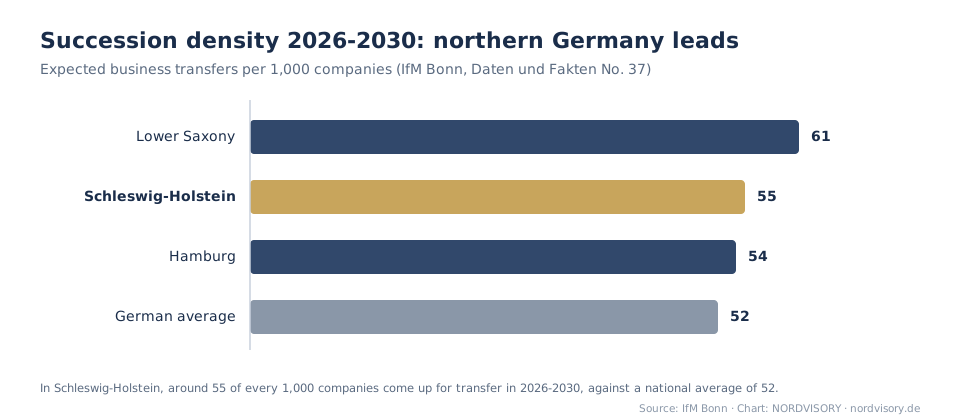
Schleswig-Holstein, the German state between Hamburg and Denmark, faces one of the country's highest business handover densities: the IfM Bonn research institute projects 55 transfers per 1,000 companies for 2026–2030, against a national average of 52. Owners are aging faster than successors arrive, which makes the state a rich hunting ground for strategic buyers, buy-and-build platforms, individual acquirers, and Scandinavian companies entering the German market.
For international and Danish acquirers, Schleswig-Holstein rarely appears on M&A radars, and that's precisely its appeal: solid Mittelstand companies in food production, machinery, logistics, renewables and services, moderate valuations, and a succession wave that brings more of them to market every year.
How large is the succession market in Schleswig-Holstein?
Germany expects around 186,000 company transfers between 2026 and 2030, per the IfM Bonn, and the highest transfer rates fall on the northern states: Lower Saxony, Schleswig-Holstein and Bremen. Schleswig-Holstein's projected 55 transfers per 1,000 companies sit clearly above the national average of 52. For the preceding five-year period, the state government already counted roughly 6,700 businesses due for handover, about 1,340 per year, and the regional chamber of commerce (IHK Schleswig-Holstein) puts the broader figure at over 12,800 member companies needing a successor or buyer within five years. On the demand side, Germany's chambers report record numbers of owners seeking successors against far fewer interested buyers, and 57% of Mittelstand owners are 55 or older (KfW Research). Outside the urban centers, family succession fails frequently because the next generation has moved away, which pushes owners toward external sales.
Which industries dominate?
The state's economic profile differs from Germany's industrial south. Food and beverage production is a traditional flagship industry, attracting strategics and consolidators seeking brands and production capacity. Machinery and metalworking firms, construction and skilled trades, logistics along the A1/A7 corridors, and care and health services form the Mittelstand core; the latter segments see heavy buy-and-build activity. Growth niches add their own buyer logic: wind energy and renewables services along the west coast, maritime suppliers around Kiel and the fjord cities, IT and software in Kiel and Lübeck, and tourism businesses along both coasts. For valuation context, German small-cap EBITDA multiples (DUB, Q2 2026) range from about 3.5x in machinery to 6.8x in IT services for companies under €5 million revenue.
Why the cross-border angle matters
Two geographic factors work in buyers' and sellers' favor. First, the Hamburg metropolitan region reaches deep into the state: the buyer pool, capital and advisory infrastructure of Germany's second-largest city are directly accessible. Second, the Danish border and the Baltic corridor: Scandinavian companies regularly acquire in northern Germany as a market-entry route, and the Fehmarnbelt fixed link is under construction, with the first of 89 tunnel elements immersed off Rødbyhavn in May 2026 and opening currently planned for around 2031, tightening the Hamburg–Lübeck–Copenhagen axis further. Danish and Nordic strategics evaluating German market entry will find succession-driven targets here at valuations well below comparable Nordic assets.
How acquisition financing works in the state
Schleswig-Holstein maintains an established public financing stack for company takeovers, relevant mainly for MBIs, MBOs and individual acquirers. The state development bank IB.SH runs the program "Gründung und Nachfolge in Schleswig-Holstein" together with the state guarantee bank, and its equity initiative "Unternehmensübernahme Plus" provides individual investments of €750,000 to €3 million, combinable with the Mittelstandsfonds and MBG equity programs up to €6 million. The Bürgschaftsbank Schleswig-Holstein issues default guarantees up to €2 million, covering up to 80% of the loan, where acquirers lack collateral. For sellers, a financed buyer pool means higher deal certainty; for buyers, these instruments materially lower the equity hurdle.
What a sale process looks like here
The process follows the German standard: four phases from preparation and valuation through confidential outreach and due diligence to a notarized purchase agreement, typically six to twelve months from mandate. Confidentiality weighs heavily in the state's close-knit regional economies, so outreach runs through anonymous profiles and NDAs. Our English-language guide to the German sale process covers the phases, timeline and German legal specifics in detail.
NORDVISORY advises owners across Schleswig-Holstein and northern Germany on sales and succession, and works regularly with acquirers from Germany and abroad. Get in touch for a confidential conversation.
FAQ
How many companies come up for succession in Schleswig-Holstein?
The IfM Bonn projects 55 transfers per 1,000 companies for 2026–2030, one of Germany's highest rates (national average: 52). The state government counted roughly 6,700 handover-ready businesses for the preceding five-year period, about 1,340 per year.
What are companies in Schleswig-Holstein worth?
Valuations follow German small-cap standards: adjusted EBITDA times an industry multiple. Per the DUB KMU Multiples (Q2 2026), sub-€5m-revenue companies range from roughly 3.5x EBITDA in machinery to 6.8x in IT services. Location barely moves the multiple; industry, size and owner independence do.
Is public financing available for acquisitions?
Yes. IB.SH, the state development bank, finances takeovers through its succession programs and provides equity up to €3 million per deal via "Unternehmensübernahme Plus" (up to €6 million combined with MSH and MBG). The state guarantee bank covers collateral gaps with default guarantees up to €2 million.
Why should Danish or Nordic buyers look at Schleswig-Holstein?
Proximity, succession-driven deal flow and price. The state borders Denmark, the Fehmarnbelt fixed link will shorten the Copenhagen–Hamburg axis, and succession pressure brings solid Mittelstand companies to market at multiples below comparable Nordic valuations. For Nordic strategics, an acquisition here doubles as German market entry.
Sources
- IfM Bonn, Company Successions in Germany 2026–2030 (opens in a new tab) (Daten und Fakten No. 37)
- State of Schleswig-Holstein, business succession portal (opens in a new tab)
- KfW Research, Succession Monitoring German Mittelstand 2025 (opens in a new tab)
- DUB KMU Multiples Q2 2026 (opens in a new tab)
- IB.SH, Unternehmensübernahme Plus (opens in a new tab) · Succession financing overview Schleswig-Holstein (opens in a new tab) · WTSH succession initiative (opens in a new tab)
Legal note: NORDVISORY is an M&A advisory firm, not a tax or law firm. Funding terms change; the institutes' current program conditions govern.
NORDVISORY is an independent M&A advisory firm based in Hamburg, advising Mittelstand owners on company sales and succession processes.
Related: The German sale process · Business succession in the German Mittelstand · Germany's closure wave · Buy-and-build in the Mittelstand