If you're acquiring a German Mittelstand company, AI exposure now belongs in your diligence scope. Only 20 percent of German Mittelstand firms use AI at all, according to KfW Research, so most targets can't tell you where their earnings sit on the substitution curve. You'll have to work it out yourself.
Why does AI exposure belong in Mittelstand diligence?
As a financial buyer you're underwriting earnings you'll own for five to seven years and sell at the end. As a strategic you have no exit date, but a longer horizon to defend. Either way, if part of those earnings rests on work that software will do more cheaply inside that window, you're paying today's multiple for a shrinking base.
That reasoning has already reshaped diligence in larger transactions. Valutico published a 2026 buyer's framework that scores AI vulnerability along four axes: dependence on third-party models, the defensibility of the target's own data, exposure to substitution by AI agents, and concentration of AI knowledge in a few people. EY describes the same mechanic for industrial businesses and names it: the AI gap discount. The arithmetic is plain. Acquirers estimate what remediation costs and deduct it from the offer.
German Mittelstand targets sit earlier on that curve. In service segments the effect is already visible. In manufacturing it mostly isn't, yet.
How much AI do German Mittelstand companies actually use?
Around 20 percent, or roughly 780,000 companies. That figure comes from Volker Zimmermann's study for KfW Research (Fokus Volkswirtschaft No. 533, February 2026, based on about 6,800 responses to the KfW Mittelstand Panel). Adoption has grown fivefold since the 2016 to 2018 period.
The spread behind that average matters more than the average:
| Segment | Share using AI |
|---|---|
| 50+ employees | 36 % |
| 10 to 49 employees | 29 % |
| 5 to 9 employees | 19 % |
| Fewer than 5 employees | 19 % |
| Knowledge-based services | 28 % |
| R&D-intensive manufacturing | 23 % |
| Other services | 17 % |
| Other manufacturing | 16 % |
| Construction | 8 % |
Source: KfW Research, Fokus Volkswirtschaft No. 533 (February 2026)
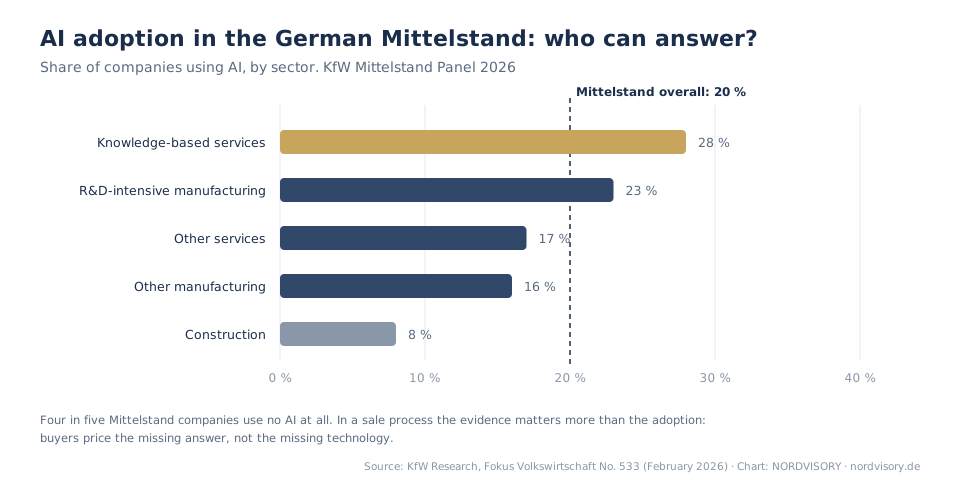
KfW's regression analysis found that sector explains little of the variation. What predicts adoption is digital and innovation activity. Companies with a documented digitalisation strategy reach 35 percent; those with no digital activity at all sit at 19 percent. Exporters reach 27 percent, while firms selling only within a 50-kilometre radius reach 14 percent.
For a buyer, that last figure is the useful one. A regionally focused, owner-managed target is statistically unlikely to have anything to show you. Absence of evidence here is weak evidence of absence, and you should price the uncertainty rather than the assumption.
Which earnings patterns carry substitution risk?
Sector labels won't help you. Two companies filed under the same NACE code can sit on opposite sides of this question. What matters is how the revenue is produced.
Four tests do most of the work. Does the work repeat in the same form, or is every job different? Does the know-how sit in people's heads or in data the company owns? Does the customer commit contractually, or buy project by project? And does something physical anchor the delivery?
| Under pressure | Better protected |
|---|---|
| Repeatable text, standard design, routine translation | Work involving plant, installation, on-site service |
| Project revenue renegotiated each time | Framework agreements and multi-year retainers |
| Pure intermediation with no data of its own | Decades of proprietary operating and customer data |
| Rules-based back-office processing | Regulated activity requiring licences or carrying liability |
| Knowledge held only by a few individuals | Documented processes and systems |
The agency market shows how far this has already travelled. FE International reports a wide 2026 spread: smaller owner-operated agencies clear 3.0x to 4.0x EBITDA, well-run firms above $1.5 million EBITDA reach 5.0x to 7.0x. Agencies with more than 80 percent of revenue under retainer price at 5.0x to 7.0x against 3.0x to 4.5x for project-led peers, and demonstrable AI tooling inside client workflows carries a premium of one to two turns.
German mid-market benchmarks run lower. The DUB KMU Multiples for Q2 2026 put media, marketing and agencies at 3.1x to 5.0x in the micro-cap band, IT services at 5.7x to 6.8x, and software and digital platforms at 6.3x to 8.0x. Our overview of EBITDA multiples by sector sets out the full table.
What should you ask in diligence?
Seven questions cover most of the ground. Ask them early, because in this market the answers usually have to be assembled rather than retrieved.
- What share of revenue comes from work that is already partly automated? You want a number in the data room, not a view from management.
- Which data does the company hold that a competitor couldn't rebuild? Twenty years of maintenance records is an asset. A customer list in a spreadsheet isn't.
- How does revenue split between framework agreements and one-off orders? Contractual commitment is the strongest defence against substitution.
- Which AI tools are in use, and what have they measurably changed? EY advises sellers to quantify this. Its model sentence is "AI contributes 250 basis points to our gross margin through predictive operations across 12 facilities", rather than a general digitalisation story. Few German targets will meet that standard, and the gap itself is informative.
- Does any of it depend on a single vendor? Valutico puts model dependency first among its four axes and tells sellers to hold a documented provider redundancy plan. Ask to see it.
- Who inside the company can operate these systems? Concentration in one or two people carries the same risk profile as owner dependency, which you're testing anyway.
- How is customer data governed? The EU AI Act allows fines up to 35 million euros or seven percent of worldwide annual turnover for prohibited practices, whichever is higher, and that exposure transfers with the shares.
How do you price what you find?
There's no defensible German mid-market benchmark yet. What exists points to direction rather than magnitude, and you should treat it that way.
EY sets out the starting position for industrial businesses: 82 percent of manufacturers lack AI-ready skills and 65 percent lack AI-ready data. Where AI does run, the same analysis reports predictive maintenance cutting downtime by 35 to 45 percent and associated cost by 25 to 30 percent. AI-powered demand sensing makes earnings more predictable, which lowers the discount rate and lifts enterprise value by 10 to 15 percent.
Valutico's 15 to 30 percent discount on valuation multiples, driven by regulatory, privacy and technical risk, applies to businesses whose product is itself AI-based. Don't transfer it to a component supplier. It's useful as a marker of how large a correction buyers are willing to make once they identify risk of that kind.
For owner-managed Mittelstand targets, a simpler rule holds. The discount attaches to the absence of an answer, not the absence of AI. Where you can't get documented facts, you'll model the unfavourable case, and so will the next bidder. That's worth saying out loud in negotiation, because it's often cheaper for the seller to produce the evidence than to concede the price.
What's different about buying into the Mittelstand?
Three things shape how this plays out in a German process.
Owner-managed targets rarely have a data room built for this question. The information usually exists inside operational systems and in the owner's head, and it takes weeks to assemble. Build that into your timetable rather than treating a thin first response as a red flag.
Second, the German mid-market prices stability over growth. On FE International's numbers, the retainer share moves the multiple further than any technology story does. A contracted, low-tech target will often defend its price better than a faster-growing project business with tooling to show. Test the revenue structure before you test the technology.
Third, German sellers respond badly to diligence that reads as a challenge to their life's work. Framing matters. Asking what the company knows about its own operating data lands very differently from asking whether the business model is obsolete. Our guide to the German company sale process covers the sequence and what sellers expect at each stage.
If you're evaluating a German Mittelstand target and want a second read on the earnings quality, get in touch for a confidential conversation.
FAQ
Does low AI adoption make a German target less valuable?
Not by itself. The valuation effect comes from unpriced substitution risk, not from the absence of tooling. A target with stable contracted revenue and no AI can be worth more than a project-led business with an AI story.
Which German sectors carry the most exposure?
Segments built on repeatable screen-based work without customer lock-in, including parts of the agency, translation and back-office services markets. Businesses involving plant, installation or on-site service carry far less exposure today.
How much of a discount is appropriate?
No reliable German mid-market figure exists. Valutico cites 15 to 30 percent for AI-native business models, and EY's AI gap discount deducts estimated remediation cost from the offer. Both indicate order of magnitude, not a number you can apply.
Will sellers have answers to these questions?
Usually not on first ask. KfW's data suggests four in five German Mittelstand companies have no AI in use at all, so the material has to be built during the process. Allow time for it.
Does this change what you pay, or what you underwrite?
Mostly what you underwrite. The practical output is a revised view of earnings durability across the hold period, which then feeds the multiple rather than replacing it.
Legal note: NORDVISORY is an M&A advisory firm, not a tax or law firm. This article provides general information and is no substitute for individual tax or legal advice.
Sources
- KfW Research, Fokus Volkswirtschaft No. 533 on AI adoption in the German Mittelstand (opens in a new tab) (Volker Zimmermann, 11 February 2026; adoption by company size and sector, based on the KfW Mittelstand Panel, 23rd wave, approx. 6,800 responses. German language)
- EY, The AI valuation shift: a point of view for industrial CEOs and their deal teams (opens in a new tab) (Mitch Berlin, Gundeep Singh, Dave Poniatowski; the AI gap discount, capability and data gaps in manufacturing, measurable effects of predictive maintenance and demand sensing)
- Valutico, AI Vulnerability in M&A Due Diligence: A 2026 Buyer's Framework (opens in a new tab) (the four diligence axes, multiple discounts for AI-native businesses, EU AI Act penalty range)
- FE International, Agency & Marketing M&A 2026 (opens in a new tab) (multiple spread in the agency market by retainer share and AI integration; figures in US dollars)
- DUB KMU Multiples Q2 2026 (opens in a new tab) (EBITDA multiples for 20 industries across 3 size brackets, aggregated from 25+ DACH M&A advisory firms)
Related reading: Business valuation in the German mid-market · EBITDA multiples by sector · The German company sale process · Buying into Northern Germany
NORDVISORY is an independent M&A advisory firm based in Hamburg, advising Mittelstand owners on company sales and succession processes.