EBITDA multiples for German Mittelstand companies range from 2.4x to 10.9x depending on industry and size, per the DUB KMU Multiples for Q2 2026. Most companies under €5 million revenue trade at 4x to 6x adjusted EBITDA. For international buyers, that's well below comparable US and Nordic private-market valuations. This page shows ten reference sectors across three size brackets and is updated quarterly.
If you're evaluating a German acquisition or benchmarking a company you own, the multiple table below is the fastest reference point. It comes from the DUB KMU Multiples, a quarterly panel aggregating the estimates of more than 25 M&A advisory firms across the DACH region, and it covers the small and lower-mid-cap segment that most international databases miss.
What are current EBITDA multiples for German companies?
The Q2 2026 panel spans 2.4x to 10.9x EBITDA across 20 industries and three size brackets. The headline reference points:
| Industry (selection) | Micro-cap (<€5m revenue) | Small-cap (€5-50m) | Mid-cap (>€50m) |
|---|---|---|---|
| Software & digital platforms | 6.3-8.0 | 7.8-9.5 | 8.5-10.9 |
| Medical technology & life sciences | 6.1-8.0 | 6.8-9.0 | 8.0-9.8 |
| IT services & system integrators | 5.7-6.8 | 6.8-8.5 | 8.1-10.5 |
| Food & beverage | 4.4-5.8 | 5.5-7.0 | 6.7-8.0 |
| Care & healthcare services | 4.0-6.0 | 5.5-7.2 | 7.7-9.6 |
| Construction & skilled trades | 3.8-5.0 | 4.4-5.8 | 5.8-7.2 |
| Transport & logistics | 3.7-5.2 | 4.5-5.6 | 5.6-7.0 |
| Machinery & plant engineering | 3.5-4.5 | 4.6-6.0 | 5.6-7.1 |
| Automotive | 2.8-4.5 | 3.8-5.1 | 4.7-6.1 |
| Consumer goods (non-food) | 2.4-4.0 | 3.5-5.5 | 4.6-6.1 |
Source: DUB KMU Multiples Q2 2026 (opens in a new tab), EV/EBITDA, sorted by micro-cap floor. The panel covers 20 industries; ten reference sectors are shown here and the full table is published by DUB. Your sector missing? Our company valuation calculator covers all 20.
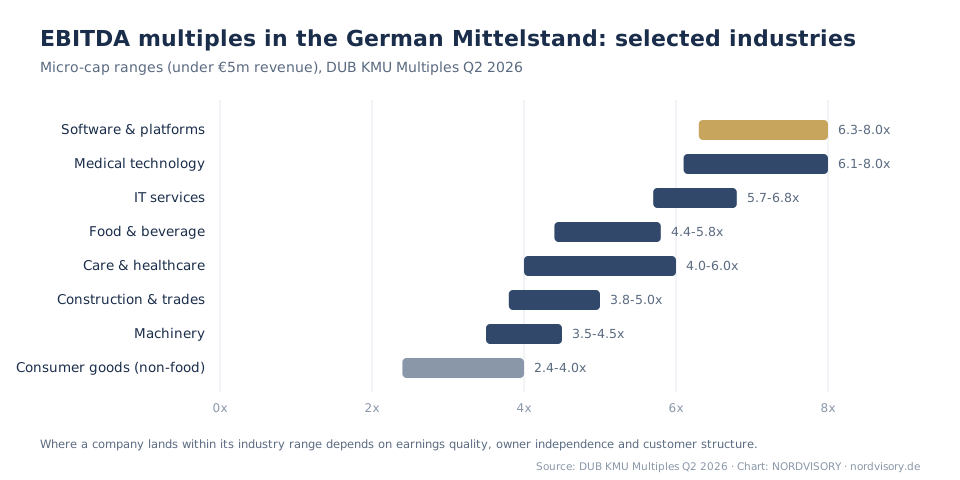
Two things to read correctly. These are enterprise value multiples, so net debt still comes off before you reach the equity price. And the ranges assume a sellable company; owner dependence or heavy customer concentration pushes a business below the bottom end.
How the size discount works
Size moves German multiples more than most buyers expect. Dealsuite's European analysis of the small firm premium puts numbers on it: companies with €200,000 of normalized EBITDA trade at an average of 3.9x, while companies with €10 million of EBITDA reach 7.2x. The DACH average across Dealsuite's monitored mid-market stood at 5.55x in H1 2025.
That gap is the engine behind buy-and-build strategies in the Mittelstand: consolidators buy small at 4-5x, integrate, and re-rate the combined group at 7x or more. If you're a strategic or financial buyer, the arbitrage is still available in most fragmented German sectors. If you're a seller, it explains why platform buyers can often outbid local rivals.
How to apply the multiple to a German target
The mechanics follow four steps:
- Normalize EBITDA. German owner-managers often pay themselves below market; the customary benchmark for a GmbH managing director's salary is around €150,000 to €169,000 per the BBE 2024 compensation study. Private expenses and one-offs come out too.
- Pick the multiple from the right industry row and size bracket, then position within the range based on earnings quality and owner independence.
- Multiply to get enterprise value.
- Bridge to equity value by deducting net financial debt.
Done properly, EBITDA adjustments routinely shift reported figures by 15 to 30 percent, which is why the adjustment schedule gets tested hard in due diligence.
One German specific worth knowing early: valuations here anchor on documented, sustainable earnings rather than growth stories. Our guides to business valuation in the German mid-market and the German sale process cover the method and the process in detail.
What the 2026 market data signals
European mid-market pricing turned upward in early 2026: the Argos Index rose 3.6% to 8.6x EBITDA in Q1 after four consecutive declines, with investment funds paying 10.0x on average against 7.8x for strategic buyers. Note the index measures €15-500 million deals, so its level sits above the SME ranges in the table; the direction, not the level, is the signal.
Supply is rising too. The IfM Bonn research institute projects around 186,000 German company successions between 2026 and 2030, and 57% of Mittelstand owners are 55 or older per KfW Research. For buyers, that means growing deal flow at moderate multiples. For sellers, it means more competition and a widening gap between well-prepared companies and the rest.
NORDVISORY advises Mittelstand owners on sell-side processes and works regularly with international acquirers. For a first indication, try our company valuation calculator, or get in touch for a confidential conversation.
FAQ
What is a typical EBITDA multiple for a German SME?
Most German companies under €5 million revenue trade at 4x to 6x adjusted EBITDA (DUB KMU Multiples, Q2 2026). Software and medtech reach 6x to 8x even at that size; automotive suppliers and non-food consumer goods start below 3x.
Why are German Mittelstand multiples lower than US private-market multiples?
Size and structure. The German SME market skews to smaller, owner-dependent companies, and valuations anchor on documented current earnings rather than projected growth. The size discount is measurable: 3.9x at €200k EBITDA versus 7.2x at €10m EBITDA across Europe, per Dealsuite.
Do the multiples refer to enterprise value or purchase price?
Enterprise value. Net financial debt is deducted and cash added to reach the equity purchase price. A target with significant bank debt costs correspondingly less at the equity level than the headline multiple suggests.
Which EBITDA figure do German advisors apply the multiple to?
Adjusted (normalized) EBITDA: owner compensation set to market rates, private expenses and one-off items removed. Adjustments of 15 to 30 percent against reported figures are common and must be documented to survive due diligence.
How current is this data?
The table reflects the DUB KMU Multiples for Q2 2026 and is refreshed each quarter when the new panel is published. Market indicators like the Argos Index are added as new quarterly readings appear.
Sources
- DUB KMU Multiples Q2 2026 (opens in a new tab) (20 industries, 3 size brackets; panel of 25+ DACH M&A advisors)
- Dealsuite, small firm premium analysis (opens in a new tab) and DACH M&A Monitor (opens in a new tab)
- Argos Index, Q1 2026 (opens in a new tab)
- IfM Bonn, company successions 2026-2030 (opens in a new tab) · KfW Research, Succession Monitoring 2025 (opens in a new tab)
- BBE media, GmbH managing director compensation study 2024
Note: multiples are valuation indications, not price commitments. Actual prices depend on the company, market conditions and process quality.
NORDVISORY is an independent M&A advisory firm based in Hamburg, advising Mittelstand owners on company sales and succession processes.
Related: Business valuation in the German mid-market · The German sale process · Buy-and-build in the Mittelstand · Taxes on selling a German company