M&A advisory fees in the German Mittelstand follow the same logic as in the US and UK: a monthly retainer plus a success fee that scales down with deal size. German sell-side mandates typically carry success fees of 3 to 7 percent of the purchase price, with minimum fees on smaller deals. Axial's 2026 fee survey of 331 US advisors shows the same pattern at 4 to 6 percent for sub-$25m deals. The engagement letter clauses, not the headline percentage, decide what you actually pay.
If you're selling a German company, or buying one and wondering how the other side's advisor is paid, the fee conventions here will look familiar. The structures mirror international practice; the levels sit within the ranges US surveys report for the lower middle market. What differs is mostly terminology and a few contract habits worth knowing before you sign.
How German M&A advisory fees are structured
Three components carry nearly every sell-side mandate. A monthly retainer of roughly €2,000 to €10,000 covers the preparation phase: financial normalization, information memorandum, buyer research. A success fee of 3 to 7 percent of the purchase price, due only at closing, carries the bulk of the compensation; the Hamburg-based Institut für Unternehmensverkauf (IFU) documents these ranges for the German market. Some firms add milestone fees for defined deliverables instead of, or alongside, a retainer. Hourly or per-diem billing is unusual in German sell-side work.
Retainers are normally credited against the success fee, so they front-load payment rather than add to it. That matches US practice: 77% of advisors in Axial's 2026 M&A Fee Guide deduct engagement fees from the final success fee. One US trend hasn't fully reached Germany yet: nearly a third of Axial's respondents now work success-fee-only, up from 19% in 2024. German boutiques mostly keep a retainer, and from a seller's perspective that's not a bad thing; an advisor with zero committed compensation has zero committed capacity.
What the numbers look like by deal size
The size degression is universal: process effort barely shrinks with deal size, so percentages rise as deals get smaller.
| Purchase price (equity value) | Typical success fee | Fee amount |
|---|---|---|
| €2 million | 5-7% (or minimum fee) | €100,000-140,000 |
| €5 million | 4-6% | €200,000-300,000 |
| €10 million | 3-5% | €300,000-500,000 |
Illustrative market ranges based on IFU-documented German conventions and Axial 2026 survey data; individual mandates vary by industry, complexity and scope.
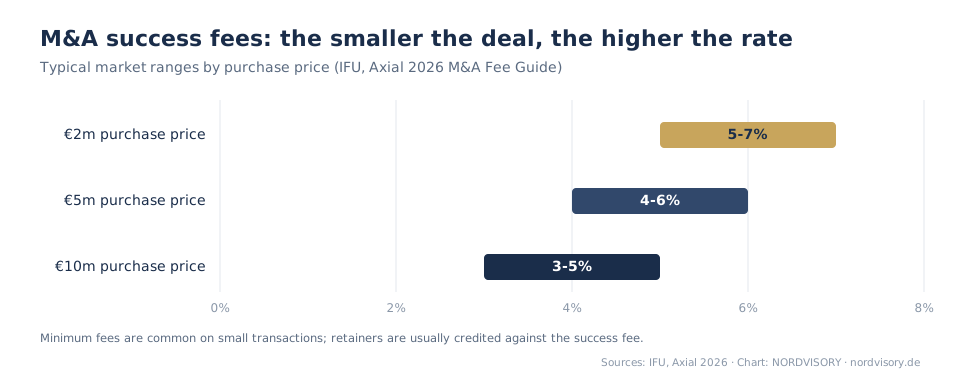
Tiered structures follow the Lehman formula (5% on the first million, scaling down to 1%) or its Double Lehman variant with doubled rates; flat percentages are gaining ground, rising from 26% to 36% of structures in Axial's year-over-year data. Minimum fees are standard on small transactions; Axial reports floors around $150,000 as common on sub-$10m US deals, and German practice is comparable in spirit if often somewhat lower in absolute terms.
Engagement letter clauses that decide the real cost
Four contract points matter more than the percentage:
- The fee base. A fee on equity value (what you receive) differs meaningfully from one on enterprise value (including assumed debt) for any leveraged company.
- Crediting. Retainers and milestone payments should offset the success fee; anything else is paying twice for the same work.
- The tail provision. If you sell to a buyer the advisor introduced after the mandate ends, the fee is still due. 12 to 24 months is the international standard, and the clause should reference a specific buyer list attached to the engagement letter.
- Term and termination rights. An open-ended exclusive mandate without an exit binds you to an advisor who may have stopped performing.
One German cost specific to budget separately: notarization. A GmbH share transfer must be recorded by a German notary, whose statutory fees depend on transaction value and come on top of advisory, legal and tax costs. Our guide to the German sale process walks through where these steps sit in the timeline.
Is the fee worth it?
The math that matters compares the fee against the outcome spread of a competitive process. In one NORDVISORY-led auction, 87 approached buyers produced six indicative offers, and the range between the lowest and highest bid dwarfed any advisory fee. Add the valuation groundwork (documented EBITDA adjustments routinely shift the negotiation basis by 15 to 30 percent) and the owner's protected management capacity during a nine-month process, and the fee question inverts: the expensive option is usually the unadvised, single-buyer sale. Where your company sits value-wise, you can check against our EBITDA multiples overview for the German market.
NORDVISORY runs partner-led sell-side processes for Mittelstand companies with a clear fee structure agreed before the mandate, not after. Get in touch for a confidential conversation.
FAQ
What does an M&A advisor cost in Germany?
Typically a monthly retainer of €2,000 to €10,000 plus a success fee of 3 to 7 percent of the purchase price, with the retainer credited against the fee (IFU). Smaller deals sit at the upper end of the range or carry minimum fees.
Are German M&A fees higher or lower than in the US?
Comparable. Axial's 2026 survey of 331 US advisors shows 4 to 6 percent success fees for sub-$25m deals with $150,000 minimums common below $10m; documented German ranges of 3 to 7 percent for the Mittelstand overlap almost entirely.
Is the Lehman formula used in Germany?
Yes, both the classic scale (5-4-3-2-1 percent per million) and the Double Lehman variant appear in German engagement letters, alongside flat percentages, which are gaining share internationally (26% to 36% year over year, per Axial).
What happens to fees if the deal doesn't close?
No success fee is due under success-based structures, but paid retainers and milestone fees stay with the advisor. Watch the tail provision: selling to an advisor-introduced buyer within 12 to 24 months after termination usually still triggers the full fee.
What other costs come with selling a German company?
Legal counsel for the SPA and warranty catalog, tax advice on the sale structure, data room costs, and German notary fees for the GmbH share transfer, which are set by statute and scale with transaction value.
Sources
- Institut für Unternehmensverkauf (IFU), advisor costs in a company sale (opens in a new tab) (German fee models and ranges)
- Axial, 2026 M&A Fee Guide (opens in a new tab) (331 US advisors surveyed, Q2 2026)
- Praxis Rock, Sell-Side M&A Advisory Fees 2026 (opens in a new tab) (Lehman variants, minimum fees, tail provisions)
Legal note: all ranges cited are market observations from the sources named, not offer terms. Fees for a specific mandate are agreed individually. NORDVISORY is an M&A advisory firm, not a tax or law firm.
NORDVISORY is an independent M&A advisory firm based in Hamburg, advising Mittelstand owners on company sales and succession processes.
Related: The German sale process · EBITDA multiples in Germany · Preparing a company sale · Taxes on selling a German company